The Web Site of Professor Paul Brians

Paul Brians (1942-) earned his PhD in Comparative Literature at Indiana University and joined the Department of English at Washington State University in 1968. He taught literature, interdisciplinary humanities, and world civilizations courses. He retired in 2008 and now lives on Bainbridge Island.
This is the website featuring Brians’ Common Errors in English Usage, photography, and various study guides and other helpful resources.
- Books by Paul Brians
- Paul Brians Vita
- “Politics & Me”: 2008 Retirement address
- Paul Brians’ Weekly Podcast (see disclaimer: next link) (*See disclaimer)
Paul Brians’ e-mail: paulbrians@gmail.com
Books by Paul Brians
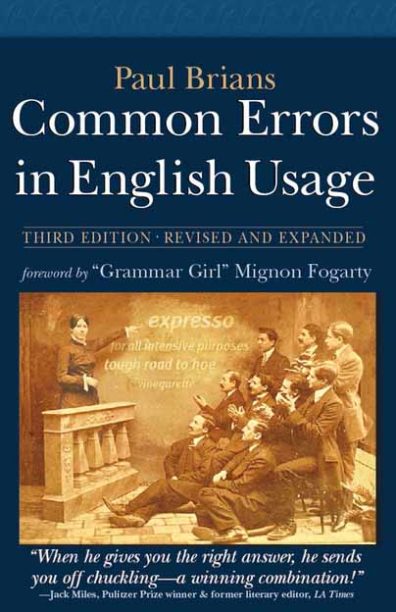
- Common Errors in English Usage (3rd Edition, November 2013)
- Nuclear Holocausts: Atomic War in Fiction 1895-1984 (1987)
- Reading About the World, Vols. 1 & 2, 3rd edition (1999)
- Modern South Asian Literature in English (2003)
- Four Seasons on Bainbridge Island, 2010
- Bawdy Tales from the Courts of Medieval France (1975)
Most recent updates
- absorbtion Although it’s “absorbed” and “absorbing” the correct spelling of the noun is “absorption.” But note that scientists distinguish between “absorption” as the process of swallowing up or sucking in something and “adsorption” as the process by which something adheres to the surface of something else without being assimilated into it. Even technical writers often confuse […]
- please RSVP / Please Reply RSVP stands for the French phrase répondez s’il vous plaît (“reply, please”) so it doesn’t need an added “please.” However, since few people seem to know its literal meaning, and fewer still take it seriously, it’s best to use plain English” “Please reply.” And for those of you receiving such an invitation, yes, you have […]
- based around You can build a structure around a center, but bases go on the bottom of things, so you can’t base something around something else. Similarly, you can’t base anything off of anything. Something is always based on something else. Back to list of errors
- seperate/separate “Separate” has two A’s separated by an R. Video created by NBC: Back to list of errors
- 100’s / hundreds It looks cheesy to spell “hundreds” as “100’s.” And it isn’t reallylogical because “100″ doesn’t mean “hundred”—it means specifically “onehundred.” Back to list of errors
*Disclaimer: This link leads to an external website that is not hosted by the university. The views and content expressed are those of the faculty member and do not represent the official positions of the university.